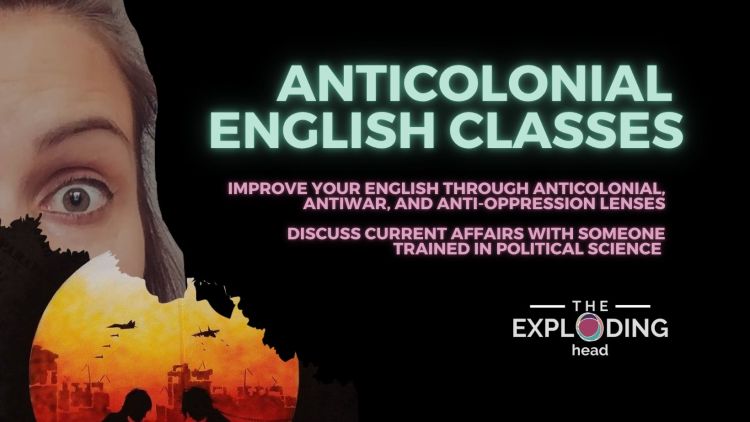
Have you ever wanted to learn a language by discussing what’s actually important to you?
Would you like to improve your English with a political commentator trained in political science as your teacher?
If you’re interested in the state of the world and you’re keen on improving your English, I invite you to study it with me.
As a lifelong language learner myself, I always yearn for meaningful conversations. I cannot wait to be able to discuss what’s on my mind in my language classes – and I know the profound joy it can bring.
What I do in my classes is go deep into anticolonial topics, using my political science and political commentator experience, bringing examples from the Global South. More importantly, I want to hear what YOU think about all of this. Because, as someone who has taught English to adults in the past, I know that no matter how chatty the teacher might be, the class is first of all about the student.
🚫 However, these classes are not for everyone. Especially if you are fine with colonialism, military occupations, and U.S. imperialism 🚫
If you are not, and you’re excited by the idea of watching interviews with UN special rapporteurs as your homework, reading articles by renowned investigative journalists in class, and discussing the most recent developments, for example, in Palestine, Cuba, or Iran, then please keep on reading.
I am offering one-on-one online classes covering different yet interconnected topics, as outlined in the Course Structure section below.
These classes are for anyone with a B2 (high-intermediate) level of English or above.
[If you don’t need to improve your English but you’d like to have regular calls with me to discuss the state of the world, please click here]
How will my classes help you?
- You will feel more confident talking about topics and regions that are important to you,
- You will have more tools and frameworks in your toolkit of how to deconstruct what’s happening in the world (you will also have the opportunity to choose which topics you would like to go more deeply into),
- You will expand your library of authors, journalists, and media platforms,
- You will have learned English in an environment that is encouraging, trauma-informed, shame-free, and – might sound unexpected – fun!
What will my course cover?
Being a white lady from Eastern Europe, I am very aware that there are topics that are not for me to cover. For example, in our climate justice class, we will talk about Indigenous climate solutions, but I can’t speak to Indigenous wisdom or ways of knowing.
However, there is a lot we can cover ethically (especially our role in the oppression of others). See the list of topics I can’t wait to talk to you about in the section below. Needless to say, my classes are always conducted in a trauma-informed way and using nonviolent language.
Course Structure
We’re learning the language of the coloniser
The -ISMs we need to deconstruct
Gender, misogyny, and chronic illnesses
Climate justice, Indigenous solutions, and green colonialism
Collective trauma, ways of healing, and the importance of rage
The invisible groups in our societies
The “Now what?”: the need to be unapologetically antifascist
These are more than English classes: these are conversations led by both curiosity and care for this planet.
Although each class has a theme, we will talk about actual places and actual events. And if you’d like to spend half a class talking about, for example, Israel’s destruction of South Lebanon, and how criminal and heartbreaking it is, that is also allowed.
What’s included:
- Flexible scheduling hours: let’s find a time that works for you
- Quick communication: if it works for you, we can be in touch via WhatsApp to accommodate any last-minute updates
- Simple course materials: notes and exercises for each class
- Homework assignments (yes, I WILL be checking your homework)
- Book, media outlet, podcast, film, etc, recommendations
Pricing
Please note that a class is 1.5 hours-long (actual hours, not academic hours).
Why? Because we can’t have a truly deep dive into any subject in a shorter amount of time. Plus, we need to have time to go over your homework assignments.
I am offering a package of 4 classes (6 hours) for $276. If you choose to buy a package, the only condition is to use it within eight weeks.
If bought one at a time: $72 per class (1.5 hours).
These are not the cheapest English classes available. I am not going for the lowest price on the market.
Why this price?
One, this is not a typical English course: it is a mix of English classes and political analyses, with a therapeutic element of being able to openly talk about what’s on your mind and heart.
Two, it also supports my ability to continue producing my independent political commentary, my pro bono work with various nonprofits, and my own charitable contributions to various causes.
If you are looking for something more affordable, I cannot provide it at the moment, yet a sliding scale (discounted prices) might be available by the end of this year.
If you are ready to say YES to having me as your teacher, choose your payment option and let’s go!
My classes are starting as early as July 1, 2026.
If you have a European bank account or can easily transfer money to such accounts, I invite you to make a transfer directly to my bank. Please leave English as a reference and send me a quick email at jposkeviciute[at]gmail.com afterward to make sure I know how to contact you.
My bank account details:
Justina Poskeviciute
IBAN: LT127300010108825692
SWIFT: HABALT22
You can also see my Revolut bank payment link here.
If you have any questions about these classes, my credentials, or anything else, please do get in touch:


Say YES to having me as your teacher or share it with anyone who you think would love anticolonial English classes ✊🏽
Justina
Don’t miss my posts – receive them directly to your inbox:
See my most recent articles and podcast episodes here:
- An Interview with Amy Goodman from Democracy Now! That You Cannot Miss
 Amy Goodman is a living legend. Her independent media work, her courage, her dedication to amplifying the voices of those who have been silenced, and her love for the world is an example to us all — and an invitation to speak out and uplift each other. Watch this amazing conversation with her now.
 - Indigeneity As The World Is Burning: We Can Either Watch The Fire, Or We Can Put Out The Centuries-Old Flames Together
 On International Indigenous People’s Day, let’s not romanticise nor dismiss the struggle that will, in the end, liberate us all.
 - Settler Violence, State Violence: The Daily Terrorism in Palestine
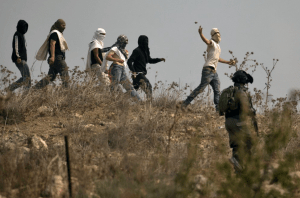 Settler violence is state violence, and it has been on the rise in the West Bank for years. See and speak out against the intensification of pogroms that we’re seeing here now, after one specific deadly attack near Nablus.
 - A Must-Watch Interview on Palestinian Armed Resistance and Israel’s Iron Dome
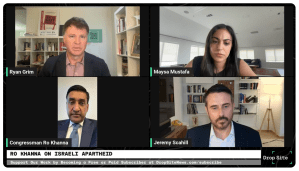 This interview is an absolute must: Jeremy Scahill talks to Senator Ro Khanna about the U.S.’s continuous support for Israel and whether Palestinians, too, have the right to armed resistance. It reveals so much of what we have been seeing: one’s unwillingness to bring full accountability to the Israeli regime.
 - On Dr. Hussam Abu Safiya And The BBC’s Irresistible Desire to Quote Israel
 We’ve had enough of the propaganda of the occupier being repeated by the legacy media. And when it still gives airtime to unsubstantiated claims by the Israeli government regarding Dr. Hussam Abu Safiya even as his life is at risk, we should be enraged.
 - How to Make (No) Sense of The New Lebanese Agreement with Israel
 As the Lebanese government signs an agreement with Israel, seemingly disregarding the leverage Iran is currently granting them, what does this all mean? What does it mean for Hezbollah, Lebanese resistance, and the future of the country itself?
 - On The Targeting of Children And The Yoga to Treat One’s PTSD afterwards (The Zionist Universe)
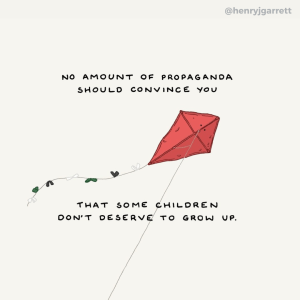 In one universe, the army of the occupier is deliberately targeting children and continuing its genocide. In another universe, the same soldiers are portrayed in a way to evoke our compassion. Can you guess which one is a Zionist universe?
 - Where The Swings Between A Human-Centric and A Fascist Government Will Stop in Colombia
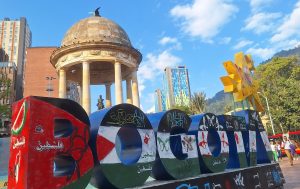 The results of the presidential elections in Colombia today will determine not only where the country is going, but whether the world will keep a loud anticolonial, anti-imperial, and antizionist government.
 - Dr. Hussam Abu Safiya and Palestinian Sumud in The Courts of The Occupier
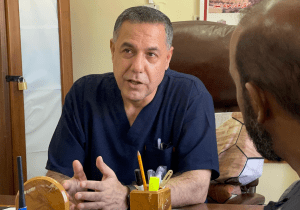 As Dr. Hussam Abu Safiya appeared via video in the Israeli Supreme Court, I invite you to name what we’re actually seeing: resistance against a fascist apartheid regime, enabled by our governments.
 The Exploding Head Media